+44(0) 1234 567 890 info@domainname.com

4 input mixer schematic

4 input mixer schematic


Portable Mixer

High-quality modular design

9V Battery powered - Very low current drawing

Design description:

The target of this project was the design of a small portable mixer supplied by a 9V PP3 battery, keeping high quality performance.
The mixer is formed assembling three main modules that can be varied in number and/or disposition to suit everyone needs.
The three main modules are:

Input Amplifier Module: a low noise circuit equipped with a variable voltage-gain (10 - 100) pre-set, primarily intended as high quality microphone input, also suitable for low-level line input.

Tone Control Module: a three-band (Bass, Middle, Treble) tone control circuit providing unity-gain when its controls are set to flat frequency response. It can be inserted after one or more Input Amplifier Modules and/or after the Main Mixer Amplifiers.

Main Mixer Amplifier Module: a stereo circuit incorporating two virtual-earth mixers and showing the connection of one Main Fader and one Pan-Pot.

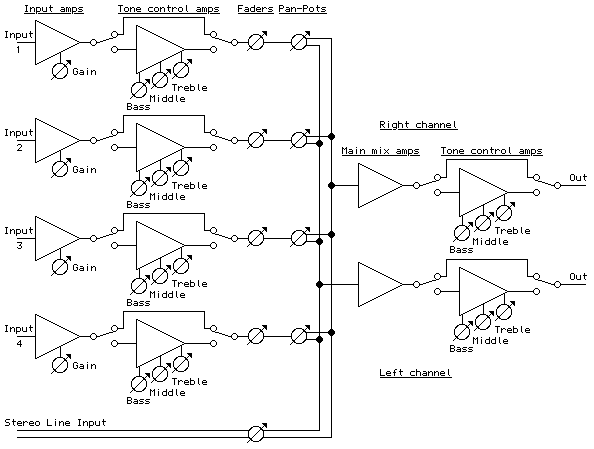
The image below shows a Block diagram of the entire mixer featuring four Input Amplifier Modules followed by four in-out switchable Tone Control Modules, one stereo Line input, four mono Main Faders, one stereo dual-ganged Main Fader, four Pan-Pots, a stereo Main Mixer Amplifier Module and two further Tone Control Modules switchable in and out for each channel, inserted before the main Left and Right outputs.
Obviously this layout can be rearranged at everyone wish.
An astonishing feature of this design lies in the fact that a complete stereo mixer as shown below in the Block diagram draws less than 6mA current!

read more 
No comments

silicon

silicon


Atomic Number: 14 Atomic Radius: 117 pm
Atomic Symbol: Si Melting Point: 1414 �C
Atomic Weight: 28.086 Boiling Point: 3265 �C
Electron Configuration: [Ne]3s23p2 Oxidation States: 2,4,-4

History

(L. silex: silicis, flint) In 1800, Davy thought silica to be a compound and not an element; but in 1811, Gay Lussac and Thenard probably prepared impure amorphous silicon by heating potassium with silicon tetrafluoride.

In 1824 Berzelius, generally credited with the discovery, prepared amorphous silicon by the same general method and purified the product by removing the fluosilicates by repeated washings. Deville in 1854 first prepared crystalline silicon, the second allotropic form of the element.
Sources

Silicon is present in the sun and stars and is a principal component of a class of meteorites known as aerolites. It is also a component of tektites, a natural glass of uncertain origin.

Silicon makes up 25.7% of the earth's crust, by weight, and is the second most abundant element, being exceeded only by oxygen. Silicon is not found free in nature, but occurs chiefly as the oxide and as silicates. Sand, quartz, rock crystal, amethyst, agate, flint, jasper, and opal are some of the forms in which the oxide appears. Granite, hornblende, asbestos, feldspar, clay, mica, etc. are but a few of the numerous silicate minerals.

Silicon is prepared commercially by heating silica and carbon in an electric furnace, using carbon electrodes. Several other methods can be used for preparing the element. Amorphous silicon can be prepared as a brown powder, which can be easily melted or vaporized. The Czochralski process is commonly used to produce single crystals of silicon used for solid-state or semiconductor devices. Hyperpure silicon can be prepared by the thermal decomposition of ultra-pure trichlorosilane in a hydrogen atmosphere, and by a vacuum float zone process.
Uses

Silicon is one of man's most useful elements. In the form of sand and clay it is used to make concrete and brick; it is a useful refractory material for high-temperature work, and in the form of silicates it is used in making enamels, pottery, etc. Silica, as sand, is a principal ingredient of glass, one of the most inexpensive of materials with excellent mechanical, optical, thermal, and electrical properties. Glass can be made in a very great variety of shapes, and is used as containers, window glass, insulators, and thousands of other uses. Silicon tetrachloride can be used as iridize glass.

Hyperpure silicon can be doped with boron, gallium, phosphorus, or arsenic to produce silicon for use in transistors, solar cells, rectifiers, and other solid-state devices which are used extensively in the electronics and space-age industries.

Hydrogenated amorphous silicon has shown promise in producing economical cells for converting solar energy into electricity.

Silicon is important to plant and animal life. Diatoms in both fresh and salt water extract Silica from the water to build their cell walls. Silica is present in the ashes of plants and in the human skeleton. Silicon is an important ingredient in steel; silicon carbide is one of the most important abrasives and has been used in lasers to produce coherent light of 4560 A.

Silcones are important products of silicon. They may be prepared by hydrolyzing a silicon organic chloride, such as dimethyl silicon chloride. Hydrolysis and condensation of various substituted chlorosilanes can be used to produce a very great number of polymeric products, or silicones, ranging from liquids to hard, glasslike solids with many useful properties.
Properties

Crystalline silicon has a metallic luster and grayish color. Silicon is a relatively inert element, but it is attacked by halogens and dilute alkali. Most acids, except hydrofluoric, do not affect it. Elemental silicon transmits more than 95% of all wavelengths of infrared, from 1.3 to 6.y micro-m.
Costs

Regular grade silicon (99%) costs about $0.50/g. Silicon 99.9% pure costs about $50/lb; hyperpure silicon may cost as much as $100/oz.
Handling

Miners, stonecutters, and others engaged in work where siliceous dust is breathed into large quantities often develop a serious lung disease known as silicosis.

Title Picture: Alchemical symbol for silicon.

No comments

15 Watt Mini Amplifier

15 Watt Mini Amplifier


Notes:
This amplifier uses a dual 20 Volt power supply and delivers 15 watts RMS into an 8 ohm load. Q1 operates in common emitter, the input signal being passed to the bias chain consisting of Q8, Q9, D6, D13 and D14. Q8 and Q9 provide a constant current through the bias chain to minimize distortion, the output stage formed by a discrete darlington pair (Q2,Q4) and (Q7,Q11). The last two transistors are power Transitors, specifically the 2N3055 and MJ2955. The 7.02K resistor, R16 was made using a series combination of a 4.7K, 680 Ohms, and two 820 Ohms. The 1.1K resistor, R3 was made using a 100 Ohms and a 1K resistor. You can use this circuit with any walkman or CD player since it is designed to take a standard 500mv RMS signal.

1 comment

0 - 300V Adjustable Power Supply

0 - 300V Adjustable Power Supply


Introduction


To prevent my high voltage experiments to go up in smoke completely, I designed
a simple circuit which can provide an adjustable voltage source of 0 to 330 Volt..
The supply is short-ciruit proof: the current is limited to about 100mA.

Circuit description

TR1 is a 1:1 mains transformer; it is included for safety.

The mains voltage from TR1 is rectified with bridge D1 (1Amp / 500V) and large elcap C1.

T1 is switched as a source follower: the source of T1 will follow the voltage of the
wiper of R3. D2 is included to protect the gate of T1; although in theory not necessary
I strongly recommend to include it!

T2 and shunt resistor R2 build the current limiter. When the output current becomes too high, T2 will discharge
the gate of T1. This will prevent the current to become too high.
The value of R3 has been determined experimentally; it depends also on the Hfe of T2 so you may need to tune the value of R2.

Note that T1 needs a large heatsink: in worst case T1 will dissipate 330V x 100mA = 33Watt!
Instead of a BUZ 326 (400V/10.5Amp) you can also use an IRF740 (400V/10Amp).
The output impedance of the power supply is determined by the beta of T1, so the larger the MOSFET
the lower the output impedance!


No comments

power supply schematic - 12 Volt 30 Amp Power Supply

power supply schematic - 12 Volt 30 Amp Power Supply

Description
Using a single 7812 IC voltage regulator and multiple outboard pass transistors, this power supply can deliver output load currents of up to 30 amps. The design is shown below:


Notes
The input transformer is likely to be the most expensive part of the entire project. As an alternative, a couple of 12 Volt car batteries could be used. The input voltage to the regulator must be at least several volts higher than the output voltage (12V) so that the regulator can maintain its output. If a transformer is used, then the rectifier diodes must be capable of passing a very high peak forward current, typically 100amps or more. The 7812 IC will only pass 1 amp or less of the output current, the remainder being supplied by the outboard pass transistors. As the circuit is designed to handle loads of up to 30 amps, then six TIP2955 are wired in parallel to meet this demand. The dissipation in each power transistor is one sixth of the total load, but adequate heat sinking is still required. Maximum load current will generate maximum dissipation, so a very large heat sink is required. In considering a heat sink, it may be a good idea to look for either a fan or water cooled heat sink. In the event that the power transistors should fail, then the regulator would have to supply full load current and would fail with catastrophic results. A 1 amp fuse in the regulators output prevents a safeguard. The 400mohm load is for test purposes only and should not be included in the final circuit. A simulated performance is shown below:


Calculations
This circuit is a fine example of Kirchoff's current and voltage laws. To summarise, the sum of the currents entering a junction, must equal the current leaving the junction, and the voltages around a loop must equal zero. For example, in the diagram above, the input voltage is 24 volts. 4 volts is dropped across R7 and 20 volts across the regulator input, 24 -4 -20 =0. At the output :- the total load current is 30 amps, the regulator supplies 0.866 A and the 6 transistors 4.855 Amp each , 30 = 6 * 4.855 + 0.866. Each power transistor contributes around 4.86 A to the load. The base current is about 138 mA per transistor. A DC current gain of 35 at a collector current of 6 amp is required. This is well within the limits of the TIP2955. Resistors R1 to R6 are included for stability and prevent current swamping as the manufacturing tolerances of dc current gain will be different for each transistor. Resistor R7 is 100 ohms and develops 4 Volts with maximun load. Power dissipation is hence (4^2)/200 or about 160 mW. I recommend using a 0.5 Watt resistor for R7. The input current to the regulator is fed via the emitter resistor and base emitter junctions of the power transistors. Once again using Kirchoff's current laws, the 871 mA regulator input current is derived from the base chain and the 40.3 mA flowing through the 100 Ohm resistor. 871.18 = 40.3 + 830. 88. The current from the regulator itself cannot be greater than the input current. As can be seen the regulator only draws about 5 mA and should run cold.
No comments

power supply schematic - Gyrator Circuit

power supply schematic - Gyrator Circuit


Description
An electronic recitification circuit. The use of large, heavy and expensive electrolytic capacitors is avoided, being replaced by an active transistor in this gyrator circuit.


Circuit Notes
To avoid excess ripple output on a power supply feeding a heavy load, usually a large value capacitor is chosen following the rectifier. In this circuit, C1's value is only a 470uF. The gyrator circuit works on the principle that the value of input capacitance at the base-emitter terminals of a transitor is effectively multiplied by the static forward current gain, HFE of the transistor. In this circuit C2, a 100uF capacitor is effectively magnified at the ouput ( Vreg ).

If you assume a dc current gain, HFE of 50 for the 2N3055 power transistor, then the effective value of the smoothing capacitor would be 50x this value; or be the same as using a 5000uF capacitor without the power transistor. The graph below shows the output voltage and current through the load :-


The load draws nearly 400mA. With the output directly from the rectifier there is about 5v pk-pk ripple in the output. Using the output at the emitter of the transistor things are much better. The circuit will take a few hundred milliseconds for the output voltage to stabilize and reach maximum value. The advantages are that a smaller, less costly reservoir capacitor can be used with this circuit to give a high quality
No comments

100W Guitar Amplifier

100W Guitar Amplifier


Guitar amplifiers are always an interesting challenge. The tone controls, gain and overload characteristics are very individual, and the ideal combination varies from one guitarist to the next, and from one guitar to the next. There is no amp that satisfies everyone's requirements, and this offering is not expected to be an exception. The preamp is now at Revision-A, and although the complete schematic of the new version is not shown below, the fundamental characteristics are not changed - it still has the same tone control "stack" and other controls, but now has a second opamp to reduce output impedance and improve gain characteristics.


One major difference from any "store bought" amplifier is that if you build it yourself, you can modify things to suit your own needs. The ability to experiment is the key to this circuit, which is although presented in complete form, there is every expectation that builders will make modifications to suit themselves.

The amp is rated at 100W into a 4 Ohms load, as this is typical of a "combo" type amp with two 8 Ohm speakers in parallel. Alternatively, you can run the amp into a "quad" box (4 x 8 Ohm speakers in series parallel - see Figure 5 in Project 27b, the original article) and will get about 60 Watts. For the really adventurous, 2 quad boxes and the amp head will provide 100W, but will be much louder than the twin. This is a common combination for guitarists, but it does make it hard for the sound guy to bring everything else up to the same level.
read more
No comments